Archives
-
UPSA Africa International & Comparative Law Journal (UAICLJ)
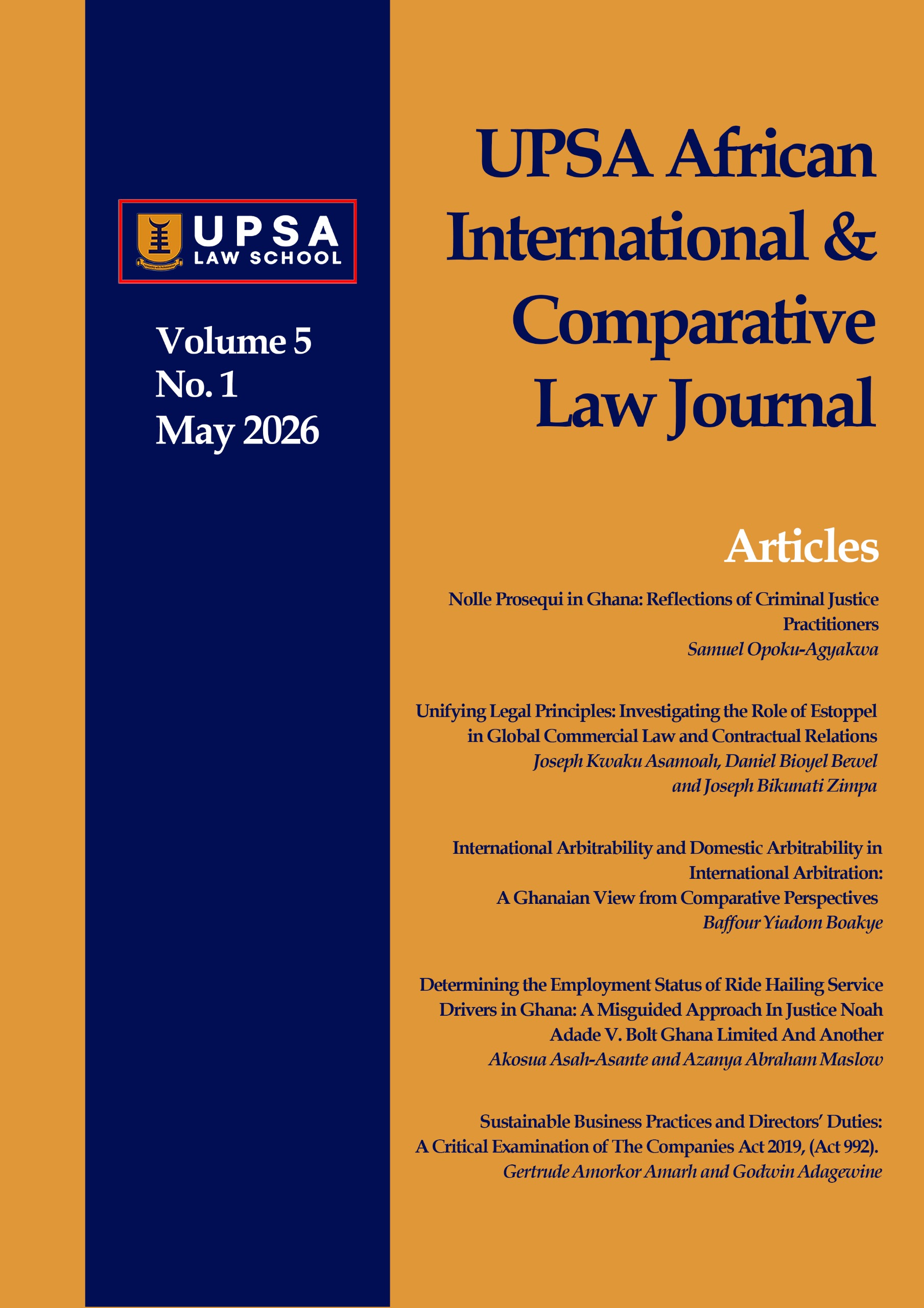
Vol. 5 No. 1 (2026)Editorial ForewordThe UPSA Africa International and Comparative Law Journal continues to grow as a platform for rigorous legal scholarship that interrogates contemporary legal developments within Ghana, across Africa, and within the broader international legal order. The publication of Volume 5 represents another important milestone in the Journal’s commitment to advancing thoughtful academic discourse, fostering comparative legal analysis, and contributing meaningfully to legal reform and policy debates.
In an era defined by rapidly evolving legal challenges, ranging from the transformation of global commerce and international dispute resolution to emerging questions about labour relations in the digital economy and the growing importance of corporate sustainability, legal scholarship must remain both critical and responsive. The contributions assembled in this volume reflect precisely that spirit. Each article engages deeply with a pressing legal issue while situating Ghanaian law within broader comparative and international frameworks.
The opening article, “Nolle Prosequi in Ghana: Reflections of Criminal Justice Practitioners” by Samuel Opoku-Agyakwa, offers an insightful examination of the use of the power of nolle prosequi within Ghana’s criminal justice system. Drawing on the perspectives of criminal justice practitioners, the article provides a reflective analysis of the legal, institutional, and practical implications of this prosecutorial power. It raises important questions about prosecutorial discretion, accountability, and the broader interests of justice within the criminal process.
In “Unifying Legal Principles: Investigating the Role of Estoppel in Global Commercial Law and Contractual Relations,” Joseph Kwaku Asamoah, Daniel Bioyel Bewel, and Joseph Bikunati Zimpa explore the enduring relevance of estoppel as a doctrinal bridge across different legal systems. Through a comparative lens, the authors examine how estoppel operates as a stabilising principle in global commercial transactions, ensuring fairness and predictability in contractual relations. Their analysis contributes meaningfully to ongoing conversations about harmonisation and coherence in transnational commercial law.
The third article, “International Arbitrability and Domestic Arbitrability in International Arbitration: A Ghanaian View from Comparative Perspectives,” by Baffour Yiadom Boakye, addresses a question that lies at the heart of modern dispute resolution: the scope of matters that may be resolved through arbitration. By distinguishing between domestic and international conceptions of arbitrability and situating Ghanaian law within comparative practice, the article offers valuable insights into the evolving architecture of international arbitration and its implications for Ghana as a jurisdiction increasingly engaged in cross-border commercial disputes.
Technological innovation and the digital platform economy have introduced new complexities into labour law. In “Determining the Employment Status of RideHailing Service Drivers in Ghana: A Misguided Approach in Justice Noah Adade v. Bolt Ghana Limited and Another,” Akosua Asah-Asante and Azanya Abraham Maslow critically examine the judicial reasoning in a landmark decision involving ride-hailing drivers. The article interrogates the legal tests applied to determine employment status and considers the broader implications for labour protection in Ghana’s rapidly evolving gig economy.
The volume concludes with “Sustainable Business Practices and Directors’ Duties: A Critical Examination of the Companies Act 2019 (Act 992)” by Gertrude Amarh and Godwin Adagewine. The authors explore the intersection between corporate governance and sustainability, analysing whether Ghana’s corporate legal framework adequately integrates environmental, social, and governance considerations into directors’ fiduciary and statutory duties. Their work contributes to the growing body of scholarship examining the role of corporate law in promoting responsible and sustainable business conduct.
Taken together, the articles in this volume underscore the dynamic nature of contemporary legal scholarship in Ghana and across Africa. They illustrate the importance of engaging with both doctrinal analysis and comparative perspectives in order to address complex legal questions in an interconnected world.
On behalf of the Editorial Board, I extend our sincere appreciation to the authors for their valuable contributions, to the peer reviewers for their careful and constructive evaluations, and to the editorial team for their dedication and professionalism in bringing this volume to publication. We are also grateful to the University and UPSA Law School for its continued institutional support for the Journal.
-
UPSA Africa International & Comparative Law Journal (UAICLJ) - Vol. 4
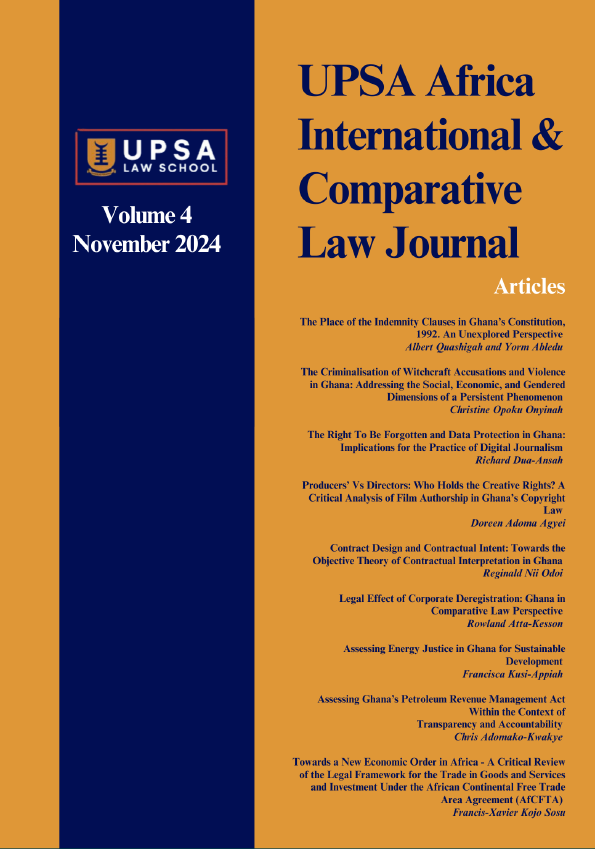
Vol. 4 No. 1 (2024)The UPSA Africa International & Comparative Law Journal is established as a platform for the publication of rigorous and cutting-edge legal scholarship that evaluates current and emerging issues in the law. It is a peer-reviewed journal dedicated to the promotion of academic work and the dissemination of knowledge in the field of law at the highest level of research and doctrinal analyses. As a periodical, the Journal is focused on maintaining the highest editorial standards and will accept only publications that make important contributions to scholarship and legal developments both internationally and within Ghana. The journal is published annually, and it invites authors to submit articles that make significant or substantial contributions to legal scholarship in general. Articles submitted must be the product of original research or analyses and are submitted on the condition that they have not been submitted elsewhere.
-
UPSA Africa International & Comparative Law Journal (UAICLJ)
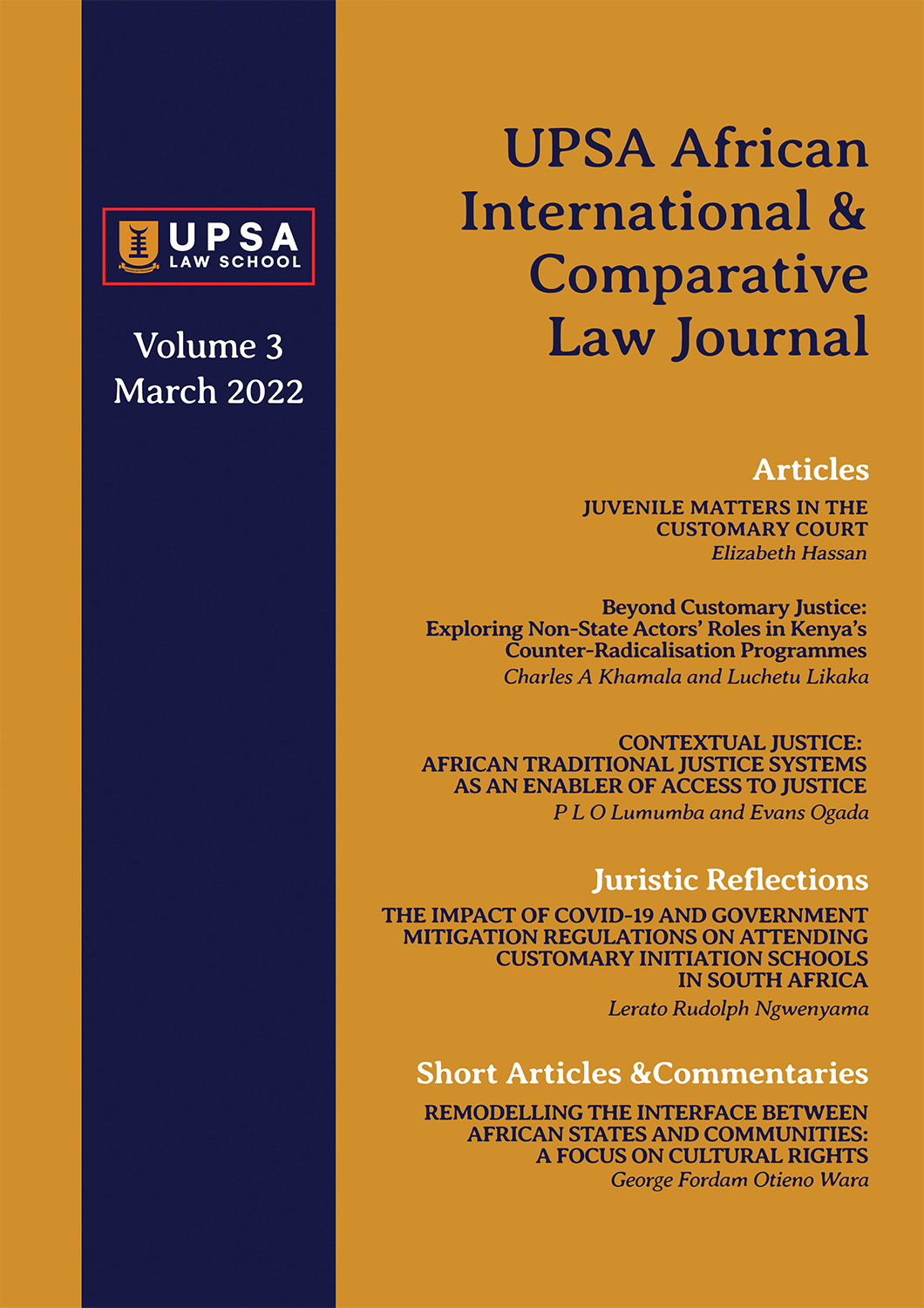
Vol. 3 No. 1 (2022)In January 2021, UPSA Law School in Accra, Ghana and the Leitner Center for International Law and Justice at Fordham Law School in New York City, convened a virtual conference to consider Customary Law in a Changing Africa. The conference included paper presentations by academics and working group discussions of a range of stakeholders including traditional leaders, members of the judiciary, non-governmental organizations, and policy makers on a number of topics, such as customary law and the rule of law, substantive and procedural aspects of customary law, the relationship between customary law, statutory law and international law, and customary law institutions. Updated versions of four of the papers initially presented at the conference are published in this Special Edition of the UPSA African International and Comparative Law Journal.
In Remodelling the Interface Between African States and Communities: A Focus on Cultural Rights, George Fordam Otieno Wara considers African communities’ struggles for survival and continuity as community systems whose cultural rights were disrupted by colonialism and relies on notions of transformative constitutions and constitutionalism to examine how constitutions can be instrumentalised to change the interaction between states and communities. In Contextual Justice: African Traditional Justice Systems as an Enabler of Accesst to Justice, PLO Lumumba and Evan Ogden also consider the impact of colonialism on African law and legal systems and explore how customary law and dispute resolution mechanisms may be used to enhance access to justice. In The Impact of COVID-19 and Government Mitigation Regulations in Attending Customary Initiations School in South Africa, Leroto Ngweyama explores the governmental regulatory effect on customary practices during the COVID-19 pandemic in South Africa.
In Juvenile Matters in the Customary Court, Elizabeth Hassan argues that the customary court system in Ghana should be used to adjudicate criminal cases involving juvenile offenders to deliver restorative justice for all impacted parties. In the final article, Beyond Customary Justice: Exploring Non-State Actors ’ Roles in Kenya’s Counter-Radicalisation Programmes, Charles A. Khamala and Alexander Luchetu Likaka explore instances where coercive state power may be exercised in the name of de-radicalisation and to evaluate when, where and how such powers should be exercised with respect to non-state actors in the effort to counter radicalization of students.