Vol. 5 No. 1 (2026): UPSA Africa International & Comparative Law Journal (UAICLJ)
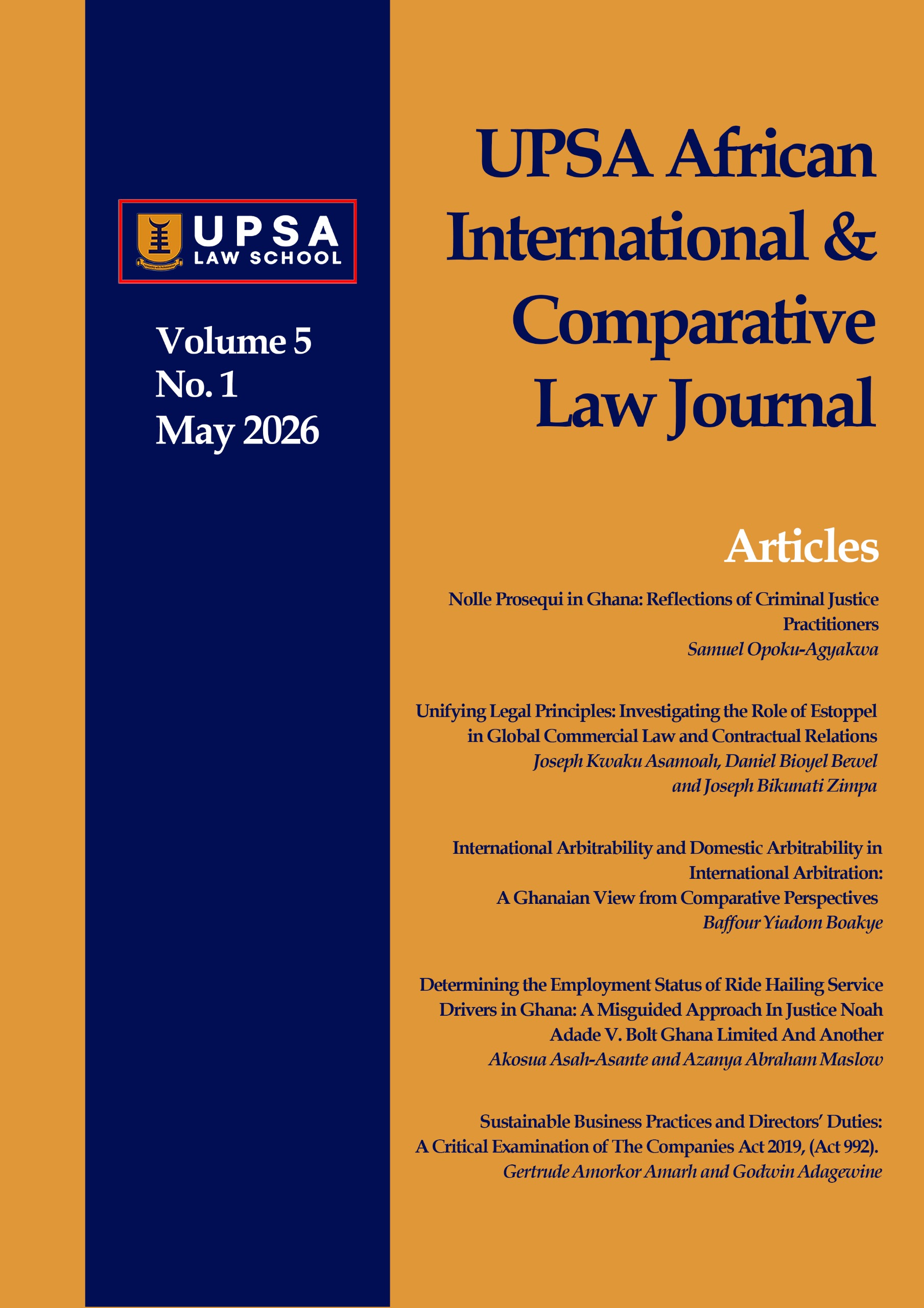
The UPSA Africa International and Comparative Law Journal continues to grow as a platform for rigorous legal scholarship that interrogates contemporary legal developments within Ghana, across Africa, and within the broader international legal order. The publication of Volume 5 represents another important milestone in the Journal’s commitment to advancing thoughtful academic discourse, fostering comparative legal analysis, and contributing meaningfully to legal reform and policy debates.
In an era defined by rapidly evolving legal challenges, ranging from the transformation of global commerce and international dispute resolution to emerging questions about labour relations in the digital economy and the growing importance of corporate sustainability, legal scholarship must remain both critical and responsive. The contributions assembled in this volume reflect precisely that spirit. Each article engages deeply with a pressing legal issue while situating Ghanaian law within broader comparative and international frameworks.
The opening article, “Nolle Prosequi in Ghana: Reflections of Criminal Justice Practitioners” by Samuel Opoku-Agyakwa, offers an insightful examination of the use of the power of nolle prosequi within Ghana’s criminal justice system. Drawing on the perspectives of criminal justice practitioners, the article provides a reflective analysis of the legal, institutional, and practical implications of this prosecutorial power. It raises important questions about prosecutorial discretion, accountability, and the broader interests of justice within the criminal process.
In “Unifying Legal Principles: Investigating the Role of Estoppel in Global Commercial Law and Contractual Relations,” Joseph Kwaku Asamoah, Daniel Bioyel Bewel, and Joseph Bikunati Zimpa explore the enduring relevance of estoppel as a doctrinal bridge across different legal systems. Through a comparative lens, the authors examine how estoppel operates as a stabilising principle in global commercial transactions, ensuring fairness and predictability in contractual relations. Their analysis contributes meaningfully to ongoing conversations about harmonisation and coherence in transnational commercial law.
The third article, “International Arbitrability and Domestic Arbitrability in International Arbitration: A Ghanaian View from Comparative Perspectives,” by Baffour Yiadom Boakye, addresses a question that lies at the heart of modern dispute resolution: the scope of matters that may be resolved through arbitration. By distinguishing between domestic and international conceptions of arbitrability and situating Ghanaian law within comparative practice, the article offers valuable insights into the evolving architecture of international arbitration and its implications for Ghana as a jurisdiction increasingly engaged in cross-border commercial disputes.
Technological innovation and the digital platform economy have introduced new complexities into labour law. In “Determining the Employment Status of RideHailing Service Drivers in Ghana: A Misguided Approach in Justice Noah Adade v. Bolt Ghana Limited and Another,” Akosua Asah-Asante and Azanya Abraham Maslow critically examine the judicial reasoning in a landmark decision involving ride-hailing drivers. The article interrogates the legal tests applied to determine employment status and considers the broader implications for labour protection in Ghana’s rapidly evolving gig economy.
The volume concludes with “Sustainable Business Practices and Directors’ Duties: A Critical Examination of the Companies Act 2019 (Act 992)” by Gertrude Amarh and Godwin Adagewine. The authors explore the intersection between corporate governance and sustainability, analysing whether Ghana’s corporate legal framework adequately integrates environmental, social, and governance considerations into directors’ fiduciary and statutory duties. Their work contributes to the growing body of scholarship examining the role of corporate law in promoting responsible and sustainable business conduct.
Taken together, the articles in this volume underscore the dynamic nature of contemporary legal scholarship in Ghana and across Africa. They illustrate the importance of engaging with both doctrinal analysis and comparative perspectives in order to address complex legal questions in an interconnected world.
On behalf of the Editorial Board, I extend our sincere appreciation to the authors for their valuable contributions, to the peer reviewers for their careful and constructive evaluations, and to the editorial team for their dedication and professionalism in bringing this volume to publication. We are also grateful to the University and UPSA Law School for its continued institutional support for the Journal.