Current Issue
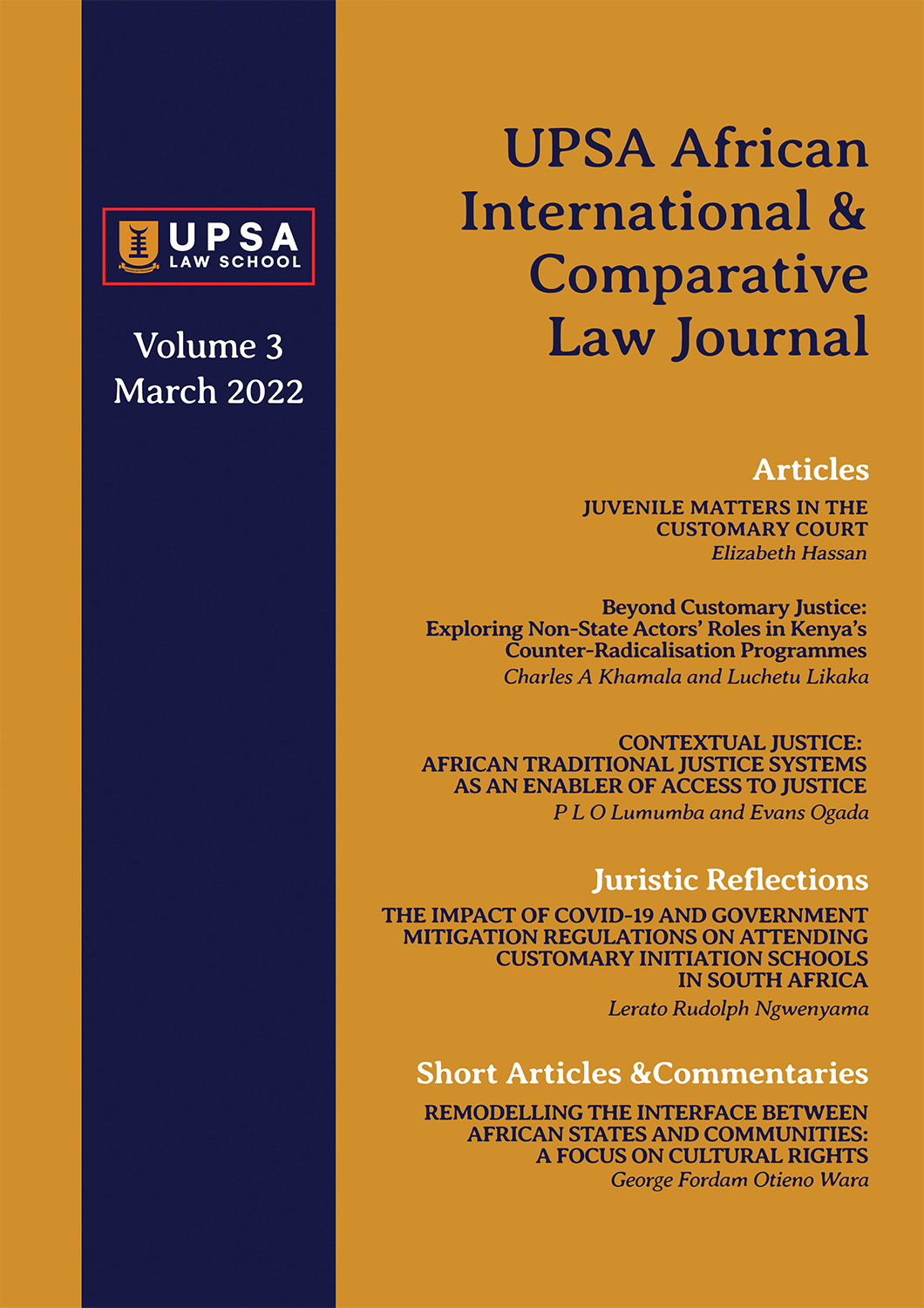
In January 2021, UPSA Law School in Accra, Ghana and the Leitner Center for International Law and Justice at Fordham Law School in New York City, convened a virtual conference to consider Customary Law in a Changing Africa. The conference included paper presentations by academics and working group discussions of a range of stakeholders including traditional leaders, members of the judiciary, non-governmental organizations, and policy makers on a number of topics, such as customary law and the rule of law, substantive and procedural aspects of customary law, the relationship between customary law, statutory law and international law, and customary law institutions. Updated versions of four of the papers initially presented at the conference are published in this Special Edition of the UPSA African International and Comparative Law Journal.
In Remodelling the Interface Between African States and Communities: A Focus on Cultural Rights, George Fordam Otieno Wara considers African communities’ struggles for survival and continuity as community systems whose cultural rights were disrupted by colonialism and relies on notions of transformative constitutions and constitutionalism to examine how constitutions can be instrumentalised to change the interaction between states and communities. In Contextual Justice: African Traditional Justice Systems as an Enabler of Accesst to Justice, PLO Lumumba and Evan Ogden also consider the impact of colonialism on African law and legal systems and explore how customary law and dispute resolution mechanisms may be used to enhance access to justice. In The Impact of COVID-19 and Government Mitigation Regulations in Attending Customary Initiations School in South Africa, Leroto Ngweyama explores the governmental regulatory effect on customary practices during the COVID-19 pandemic in South Africa.
In Juvenile Matters in the Customary Court, Elizabeth Hassan argues that the customary court system in Ghana should be used to adjudicate criminal cases involving juvenile offenders to deliver restorative justice for all impacted parties. In the final article, Beyond Customary Justice: Exploring Non-State Actors ’ Roles in Kenya’s Counter-Radicalisation Programmes, Charles A. Khamala and Alexander Luchetu Likaka explore instances where coercive state power may be exercised in the name of de-radicalisation and to evaluate when, where and how such powers should be exercised with respect to non-state actors in the effort to counter radicalization of students.
Full Issue
The UPSA Africa International & Comparative Law Journal, established in 2021, is a platform for the publication of rigorous and cutting-edge legal scholarship that evaluates current and emerging issues in the law. It is a peer-reviewed journal dedicated to the promotion of academic work and the dissemination of knowledge in the field of law at the highest level of research and doctrinal analyses. As a periodical, the Journal is focused on maintaining the highest editorial standards and will accept only publications that make important contributions to scholarship and legal developments both internationally and within Ghana.